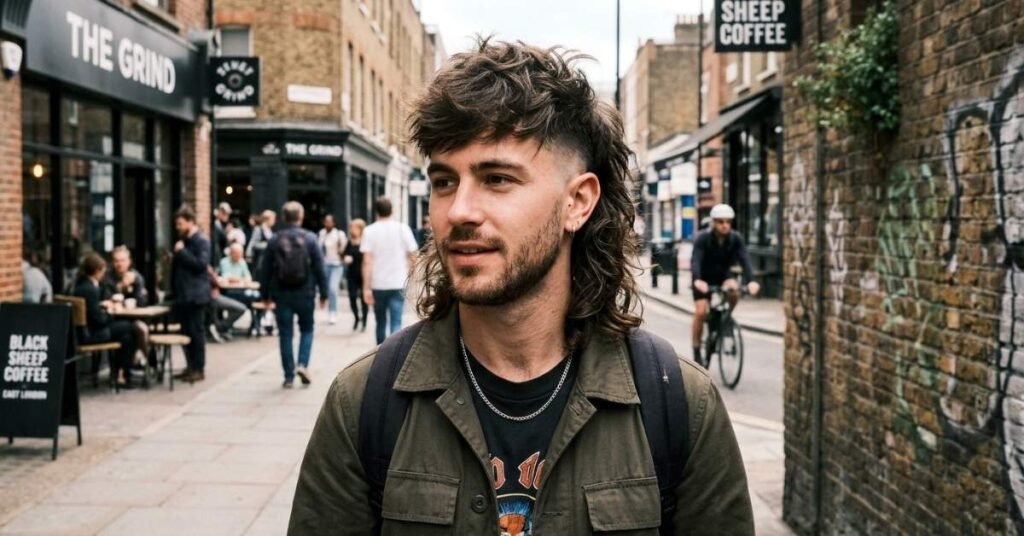
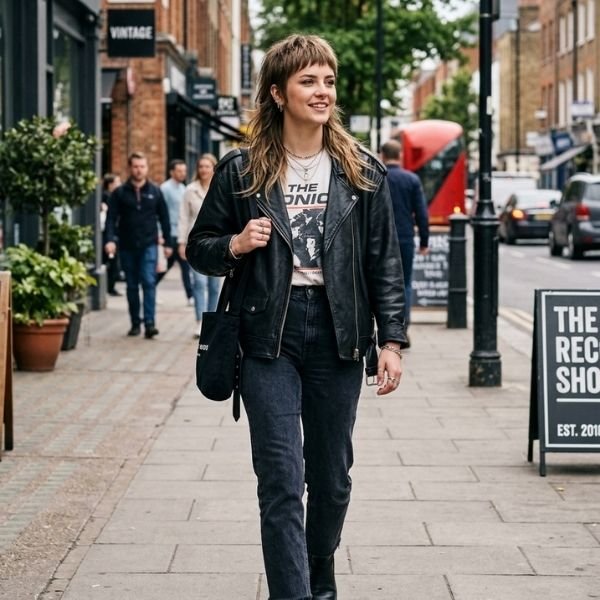
The mullet is back, and it looks nothing like your uncle’s 1985 photo. Today’s modern mullet haircuts keep the short-front, long-back shape but add clean fades, soft layers, and real texture.
This guide covers 25 styles, how to style them at home, what to tell your barber, and where the cut really comes from. Whether you want something bold or just a little edge, there is a version here for you.
Table of Contents
Trending Modern Mullet Haircuts for Men
Each style below includes who it suits and what to ask for. Show your barber a photo too. It saves time.
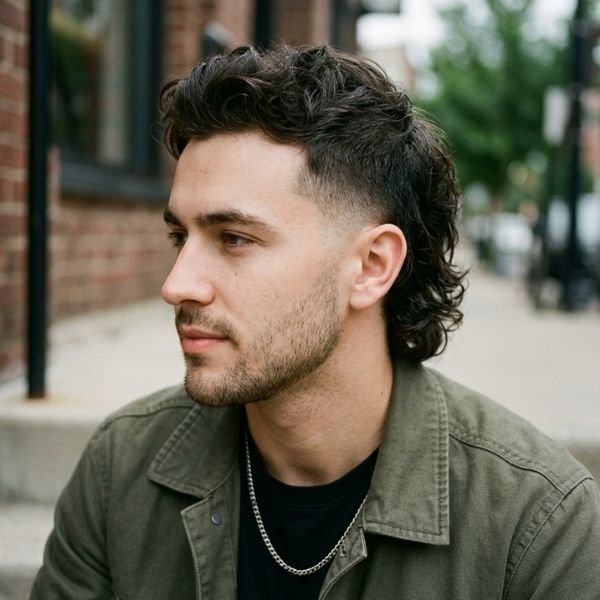
Modern Mullet
The modern mullet keeps the sides short and tidy while leaving length at the back. It is cleaner and softer than the old-school version.
- Best for: Straight or wavy hair
- Ask your barber for: A tapered side blend and a textured, neck-length back
Long Mullet
The long mullet leaves the back well past the collar. It grabs attention fast, so it works best on healthy, thick hair.
- Best for: Confident, fashion-forward guys
- Ask your barber for: Light layers in the back to avoid a heavy, flat look
Mullet Taper Fade
This is the easiest entry point. The sides shorten gradually toward the ear and neckline, so the change looks gentle, not harsh.
- Best for: First-time mullet wearers and office settings
- Ask your barber for: A taper fade with the back left at mid length
Mohawk Mullet
Here the top runs long down the center while the sides are faded short. It adds height and a punk feel without losing the long back.
- Best for: Thick or curly hair
- Ask your barber for: A skin or low fade with a defined strip on top
Short Mullet

A short mullet is a smaller step into the trend. The back is only slightly longer than the sides, which keeps it low maintenance.
- Best for: Men who want a subtle look
- Ask your barber for: A short, textured top and a back that just touches the collar
Burst Fade Mullet
A burst fade curves around the ear and fades out behind it, so the back keeps its length. It is one of the most requested mullet styles right now.
- Best for: Textured, thick, or curly hair
- Ask your barber for: A low or high burst fade with mid-to-long back length
Curly Mullet
Natural curls make a mullet look full and bouncy with very little effort. The curls add shape that straight hair has to fake.
- Best for: Medium to tight curls
- Ask your barber for: A fade on the sides and a curl-friendly cut on dry hair
Mullet Fade
A mullet fade blends the sides down to the skin or close to it, then lets the top and back run longer. The contrast is sharp and eye-catching.
- Best for: Men who like clean lines
- Ask your barber for: A low, mid, or high fade based on how bold you want to go
Shaggy Mullet
Layers and movement define the shaggy mullet. It looks lived in, a bit rock and roll, and it forgives a messy morning.
- Best for: Wavy or thick hair
- Ask your barber for: Long, choppy layers with a loose, undone finish
Two Block Mullet
The two block cut keeps the top long and the lower section short, with a clear break between them. It has strong Korean fashion roots and a very modern shape.
- Best for: Straight, thick hair
- Ask your barber for: A disconnected undercut with a long, layered top
Trendy Short Mullet with Low Taper Fade
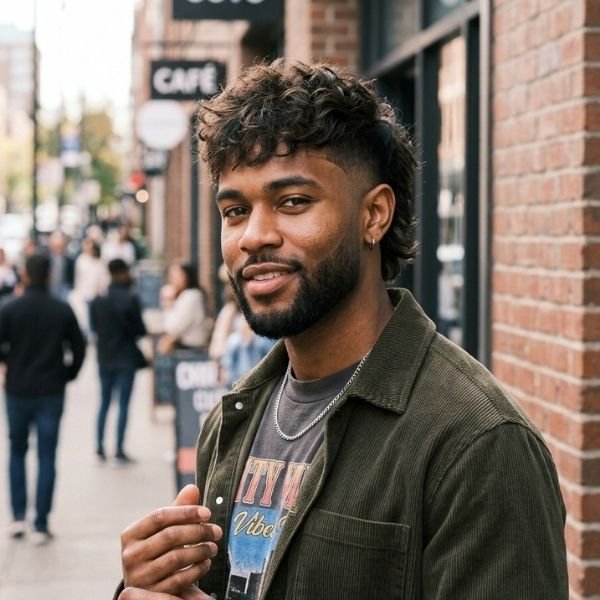
This version pairs a compact mullet with a low taper that hugs the hairline. It looks sharp without much upkeep.
- Best for: Work-friendly style with a little edge
- Ask your barber for: A low taper and a short textured back
Mullet Faux Hawk
The faux hawk mullet pulls the top upward into a soft ridge. The sides stay tight, and the back adds the mullet shape.
- Best for: Guys with medium-thick hair
- Ask your barber for: Length on top that can be pushed up and a faded side
Temp Fade Mullet
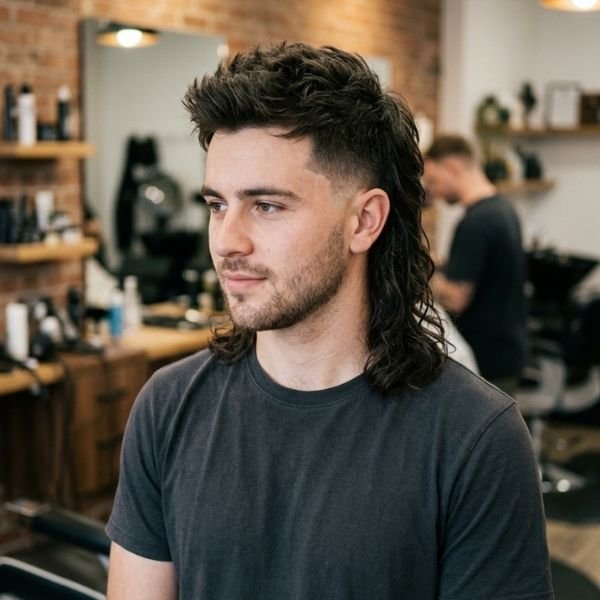
A temp fade, also called a temple fade, focuses the blend around the temples and sideburns. It frames the face well and keeps the rest of the cut easy.
- Best for: Anyone who wants a clean face-framing outline
- Ask your barber for: A temple fade with a tapered neckline
Faded Mullet with Fringe
A fringe falls over the forehead while the sides are faded and the back stays long. The mix of front softness and side sharpness is very popular.
- Best for: Men who want to cover a high forehead
- Ask your barber for: A textured fringe and a mid fade
Fluffy Mullet

This style relies on volume. The hair is cut with soft layers so it sits airy and full, almost like a blowout.
- Best for: Fine to medium hair that needs lift
- Ask your barber for: Feathered layers and a blow dry finish
Sexy, Modern Mullet From The Back
Seen from behind, this mullet shows its best feature: a clean, graceful line from the crown to the nape. The back is longer than the sides, with a sharp or softly tapered edge.
- Best for: Men who care about the rear view
- Ask your barber for: A well-shaped nape and even length across the back
Messy Mullet with Texture
Messy does not mean careless. This cut is built with texture so it looks tousled on purpose.
- Best for: Casual, relaxed style
- Ask your barber for: Point cutting or razor texture throughout
Edgy Mullet with Beard
A mullet and a full beard make a bold pairing. Keep the beard shaped and blended into the fade so the look stays balanced.
- Best for: Oval or square faces
- Ask your barber for: A fade that connects smoothly to the beard line
Classy Mullet

Not every mullet needs to shout. A classy mullet keeps clean sides, a neat top, and a back that is long but tidy.
- Best for: Professional settings
- Ask your barber for: A low taper and a combed, controlled finish
Quiff Mullet Fade
Combine a lifted quiff on top with a faded mullet shape and you get height and flow in one cut. It leans retro but still feels fresh.
- Best for: Medium-thick, straight or wavy hair
- Ask your barber for: A longer front section styled up and back, with a mid fade
Permed Mullet Taper
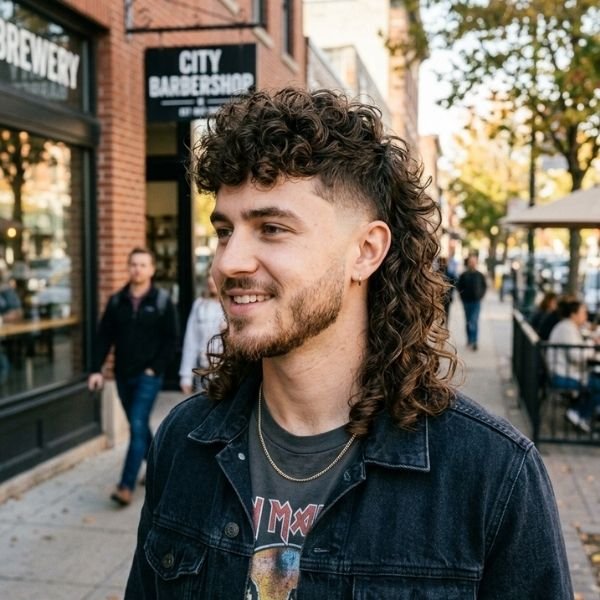
A perm adds curls to straight hair, and the taper keeps the sides neat. It is a big change, but it gives lasting texture.
- Best for: Straight hair that needs body
- Ask your barber for: A soft perm on top and back with a taper on the sides
Medium Mullet
The medium mullet is the sweet spot for many guys. The back sits around the nape or collar, so it is noticeable but easy to manage.
- Best for: Almost everyone
- Ask your barber for: A mid-length back with light layers
Spiky Mullet
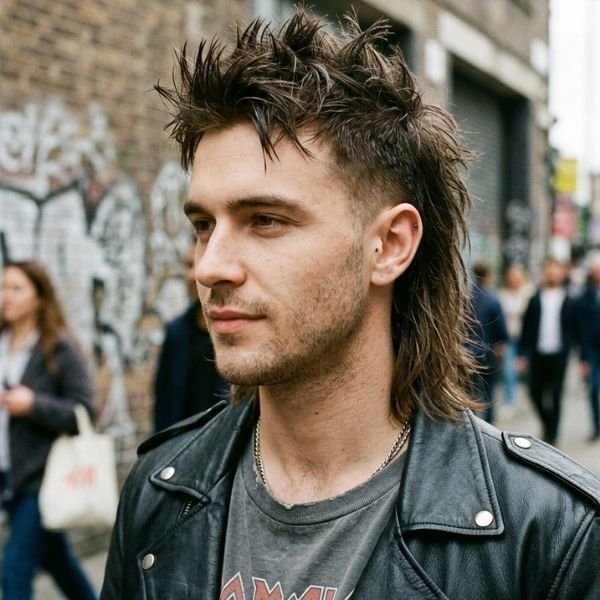
Short, pointed texture on top gives this cut a lively, youthful shape. The back stays slightly longer for the mullet silhouette.
- Best for: Short to medium hair
- Ask your barber for: Choppy top layers and a tapered side
Choppy Mullet Taper Fade
Uneven, choppy ends create movement, while the taper keeps the sides smooth. It gives you texture and neatness together.
- Best for: Thick or coarse hair
- Ask your barber for: Razor-cut ends and a taper fade
Flowing Mullet
This style has longer, softer layers that move naturally as you walk. Think smooth and airy, not spiky.
- Best for: Wavy hair with good density
- Ask your barber for: Long layers and a gentle blend on the sides
Quick fade guide:
- Taper fade: Gradual shortening at the neckline and sideburns. Most subtle.
- Burst fade: A rounded fade around the ear. Keeps back length.
- Temp fade: Focused on the temples. Great for framing.
- Skin fade: Goes down to bare skin. Highest contrast.
How To Style A Mullet
A good mullet needs a little product and a few minutes. Follow these steps for a clean, textured finish.
Step 1: Apply A Volumizing Shampoo and Conditioner
Start with a volumizing formula. It lifts roots and keeps layers from falling flat. Condition the ends only, so the top doesn’t get weighed down.
Step 2: Add Texture with A Sea Salt Spray
Spray evenly on damp hair, from roots to ends. Scrunch lightly. This gives the grip and beachy movement a mullet needs.
Step 3: Use A Hair Diffuser
Attach a diffuser to your dryer and use low heat. Dry in sections, lifting from the roots. This is especially helpful for curly and wavy mullets because it reduces frizz.
Step 4: Apply Styling Clay, Matte Pomade, or Texturising Powder
Choose one product based on your hair:
- Styling clay: Strong hold for thick or spiky styles
- Matte pomade: Medium hold and a natural finish
- Texturising powder: Instant volume for fine hair
Warm a small amount between your palms and work it through from the back to the front. Use less than you think you need. You can always add more.
Maintenance tip: Book a trim every 4 to 6 weeks to keep the fade sharp. The back can wait longer, but the sides and neckline get untidy fast.
What Is A Mullet Haircut?
A mullet haircut is a style with shorter hair on the top and sides and longer hair at the back. The classic line is “business in the front, party in the back.”
A modern mullet is a softer version of that idea. It uses fades, tapers, and layers so the shape looks cleaner and fits more face shapes and workplaces.
Which face shapes suit a mullet?
- Oval: Most variations work
- Square: Textured or fringe styles soften the jawline
- Round: Add height on top to create length
- Long: Choose a shorter back and some fringe to balance the face
How to ask your barber for a mullet:
- Bring two or three photos.
- Say how short you want the sides and what fade type you prefer.
- Tell them how long the back should be.
- Mention your daily routine and hair type.
Explore More Grooming Guides
Keep going with these related reads:
- Crew Cut: The Ultimate Sharp Style For Men
- 37+ Mid Fade Haircuts Men Love for a Sharp, Modern Look
- 30 Modern Mullet Fade Hairstyle 2026
- Haircut Maintenance Cost Calculator
✨ The Evolution of the Mullet Haircut
The mullet is much older than most people think. Homer’s Iliad describes warriors with cropped forelocks and hair grown long at the back, which is an early written hint of the shape. history
In the early 1970s, David Bowie’s orange Ziggy Stardust hair pushed the look into pop culture. Rod Stewart, Keith Richards, and Paul McCartney also wore versions of it during that decade. proseWikipedia
The name came later. The Oxford English Dictionary says the Beastie Boys apparently coined, and certainly popularized, the term through their 1994 song “Mullet Head”. They did not invent the haircut. They named it. Wikipedia
After that, the mullet became a joke for years. In the 2010s and 2020s it returned, this time with softer layers or a burst fade. Today it is a proper fashion cut, seen on barbershop floors and social feeds everywhere. barber
Conclusion
Modern mullet haircuts give you range. You can go subtle with a taper fade or bold with a burst fade and curls. The right pick depends on your hair type, face shape, and how much time you want to spend styling.
Start with a photo, a clear request, and a barber you trust. Add a simple routine of salt spray, a diffuser, and a matte product, and keep up regular trims. That is all it takes to wear a mullet well in 2026.
FAQs About Modern Muller Cut!
What hair type is good for mullet?
Thick, wavy, and curly hair work best because they hold shape and texture. Fine straight hair can still work with layers, a perm, or texturising powder.
Why are mullets so attractive?
They mix sharp, clean sides with relaxed length, which feels both edgy and stylish. They also suit many face shapes and let you show personality.
Who made the mullet famous?
David Bowie’s Ziggy Stardust look made it famous in the early 1970s, and the Beastie Boys popularized the word “mullet” in 1994.
How many types of mullet are there?
There is no fixed number, but common types include the classic, modern, short, medium, long, curly, shaggy, burst fade, taper fade, and mohawk mullet.
How to grow mullet?
Let the back grow while trimming the sides every few weeks. Hair grows about half an inch a month, so expect 6 to 12 months to reach a full mullet.

George is a passionate hair expert with 4 years of experience in hairstyling, grooming, and hair care. He shares practical tips, trends, and professional advice to help readers.